Valorant: Does Jett Suck?(Revised)

How does an individual survive in a team based game?

In recent years I’ve fallen out of love with the FPS genre. The amount of time I have doesn’t really allow me to follow many recent big budget games either. Because of my recent indulgence into Twitch however, I’ve been able to watch one of my favorite streamers play Valorant a lot and it has got me thinking about character balancing.

As I’ve been watching Valorant over the past month, one character in particular has been bothering me. Her name is Jett and she stands out from the rest of the character roster as too much of an individual. I’ve been grappling with whether this solo mentality makes her a good character or not, but with the game so early in release, I wanted to share my observations so far.

What is Valorant?

Valorant is a team based tactical shooter where each character has their own tangential playstyle. There are 10 characters available for a player to choose with the exception that you can’t have duplicates on a team (for a full list of characters and their abilities see the info here). Teams are either attackers, planting a spike (the bomb) at one of several locations on the map, or defenders, who try to eliminate the team and/or defuse the bomb. The game is best of 25. For those of you who can’t get their hands on the closed beta of the game, the best way to describe it is a cross between Overwatch and Counter Strike: Global Offensive (CS:GO). 

Why am I interested in Valorant?

Valorant isn’t new in its execution of character expression, but what interests me is the idea that a character is only half of a player’s ability in-game. Typically in a team based shooter, each character railroads the player into a very different playstyles based on the weapons they have available and their movement patterns. However, in Valorant every character has access to the same guns. This puts everybody on the same playing field and technical skills with guns will be universal rather than niche to a character.

Much like CS:GO, information in Valorant is paramount to success. It’s very easy to kill people in game (headshots are instant kills) and you only get one life per round. This means that reckless playstyles are pretty much nonexistent. It’s important to be cautious and use as much information as you can to be successful.

What makes a character good in Valorant?

As mentioned before, what makes for successful play is information, but this also is balanced with how well you can handle a weapon. Since weapon handling is universal to every character, we will only focus on what a player can do with their character abilities. The best characters in the game will either have abilities that support how effective they kill enemies, or control the flow of game information. The only exception to this rule is Sage who also provides healing as a support character.

What is Information in Valorant?

In its simplest form, information is where the enemy is located on the map at any time. At the start of the round, the enemy has several locations where they want to plant the spike so knowing which location they are heading to will help you stop them. Sometimes if a location is too much trouble, they will do what is called “rotating,” which means to change plans and go to another location mid-round. Obviously, if you can know when they are rotating, relocating as a team will be much easier. Information is also important for execution. Some character abilities might not give away information directly, but it might cover enough of a surface area on the map that allows you to make deductions about where the enemy may or may not be.

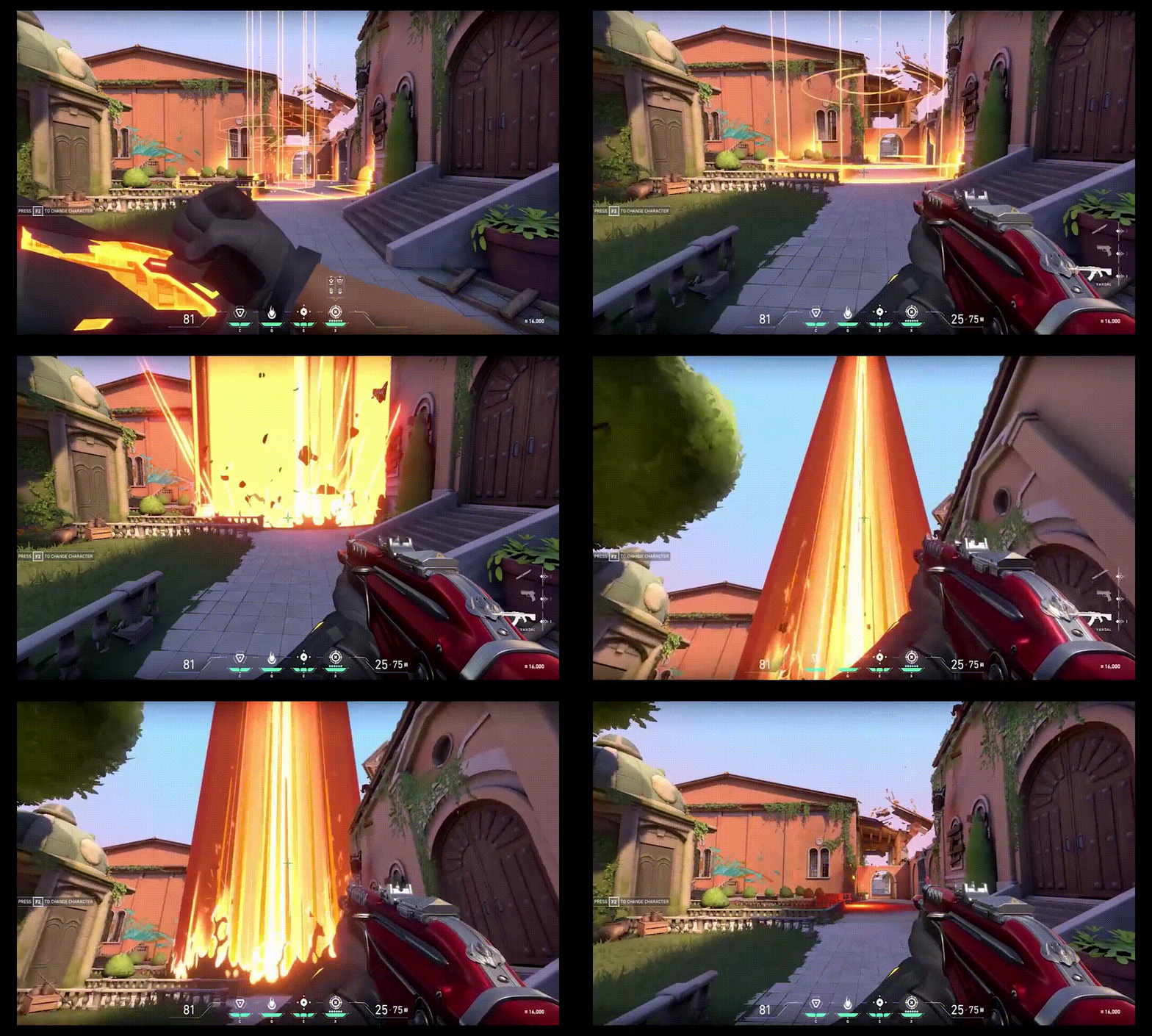
For example, the character Brimstone has an ability called Orbital Strike. It is a vertical cylinder of pain that lasts for a few seconds. Staying in this blast radius is lethal, so it’s safe to assume any player on the map is either not in that circle or dead. This may not sound very useful, but its uses vary. It can clear close quarters spaces, prevent players from entering certain locations, force them out of hiding spots, or stop them from planting/defusing the bomb for a few seconds.

“Prepare for Hell Fire!”

Lastly information can be manipulated or blocked. The most common ability to do this is a vision-blocking cloud. These are simply opaque spheres that can be walked through, but completely block your line of sight regardless if you are inside it or not. Other abilities include flares that temporarily blind the player or reduce their vision, or a literal wall that also obscures vision and movement.


Any character that can provide or manipulate location data on the enemy is highly valued on the team and any character that can deduce player location with their ability is a close second. (All in depth info on abilities are here.)

In terms of information, characters that do this well are:

Sova and Cypher

Both characters have multiple abilities that directly scope out player information such as Sova’s Recon Bolt or Cypher’s Spycam. Both characters were built with the intention of being the eyes of the team, but do so in two different ways.

Sova’s Recon Bolt in action.

In second place is:

Breach, Brimstone, Omen, Phoenix, Sage, Raze, and Viper

Each character in this rank has at least two abilities that manipulate/block information, but their character has other abilities that make them more well rounded. Examples include Breach’s ability to shoot a flash through a wall, Phoenix’s ability to put down a pool of fire on the ground, or Sage’s ability to put up a large wall anywhere within visible sight.

In last place we have:

Jett

She is the only character on the roster that has only one ability to block information. Her ability is called Cloudburst, which allows her to place 3 different vision-blocking clouds per round. The only drawback to her clouds is that they have the shortest lifespan from any other character’s clouds. Because of this, she brings the least amount to the table in terms of information.

Jett’s Cloud Burst ability

(Why don’t I put Raze at the bottom?)

While Raze doesn’t have a traditional ability to draw information, she has two abilities that can act like eyes for her. Her Bomb Bot is a small robot that seeks out and blows up an enemy player and her Paint Shells are grenades that blow up into smaller grenades. Neither ability is a normal info-gatherer, but if she sent these out around corners, she could bait players into moving into her vision or at least inform her that they are close.

How can a character’s ability kill?

Gun ability aside, most characters have some sort of ability that allows you to combat enemies in different ways. Examples include a stronger gun, shots that can go through walls, or movement blocking abilities that damage the player to traverse through. These abilities tend to pack a stronger punch than normal gunshots, so mastering how to use each ability will make for the most effective play for a character.

The best character in this department is Raze, due to all of her abilities providing some sort of damage to enemies. The worst in this department are Cypher and Omen, who have no abilities that damage players. A close second however is Jett and Breach, who both have one.

It’s not too important to be hung up on how much a character can kill with their abilities because they still can use their guns anyways, but it’s important to note that if you do want to mix up your enemy, these characters at the bottom have the least in their toolbelt.

Does Jett Suck?

As we can see above, Jett seems to be at the bottom of each list for what each character can bring to the table. With providing information being the more important of the two abilities, it doesn’t seem like Jett offers all that much.

So what’s the deal with Jett then?

What makes Jett a weird character for Valorant is that she was built from the ground up as a loner. The first indication of this is literally on the promotional art and advertising of the game.

Much like Overwatch and Team Fortress 2, Valorant prides itself on a diverse cast of characters, yet Jett seems to be the only character on the majority of the promotional material, despite the few exceptions with Phoenix making an appearance too. Other indications come from her voice lines in game.

Each character comes with a plethora of different voice lines for various occasions, some for winning, losing, enemy information, and just stingers to liven up the game. While most characters have the occasional joke, Jett seems to be the most overwhelmingly sarcastic. Her role as a loner can be summed with the line: “I got your backs. Just…you know… from the front.” Her lines tend to have a sort of comedic arrogance that is most reminiscent of Iron Man and Deadpool. When she wins a round as MVP she says “Oh my back hurts! Everyone’s so heavy” as an allusion to the term “carrying the team.” She will occasionally joke “I would make fun of their dumb faces but they’re us! Heh! We look stupid” to point out that both teams can have the same characters on the field at once.  When she uses her ultimate ability she yells “Get out of my way!” which indicates a sort of solo presence in her opposition. The most interesting line to me is if she is resurrected by Sage, she simply says “Cool.” It’s this apathy to death itself that really makes me think that she either stands alone from the cast in cognition of the fourth wall, or that she doesn’t really take the idea of being on a team seriously.

Jett’s abilities only seem to benefit her for the most part as well:

  • Cloudburst – She can lay down 3 vision blocking clouds. As stated before, they last the least amount of time. Only Jett or people really close to Jett could really benefit from this.
  • Updraft – This allows her to jump higher than normal. This is great for getting to higher parts of the map, but its uses on the map are very limiting for true places of unique reconnaissance.
  • Tailwind – She can propel in a direction she is moving for a second. Much like updraft, it has a good use of an evade, but aside from that it doesn’t provide much for info.
  • Blade Storm – She spawns 5 knives that can be thrown accurately for a kill. While a great offensive move, her ability serves no other purpose.

So what does Jett have to offer to the team?

Cloudburst aside, Jett’s ability to evade and jump makes her hard to hit. She could provide bait or hide in a high spot to surprise enemies. At heart, Jett’s character is more of an executor rather than a spy, but she will need all of the info she can get from other players first to actually be effective though. She even says it in several of her lines:

  • “Yo Brimstone. You know the drill. Just show me where to go.”
  • “Cypher, just tell me where they are. I’ll do the rest”

One thing that should be noted is that just because Valorant is a team game, it doesn’t mean that you will always be on the best team possible. Much like any multiplayer game online, teams will either be composed with people you trust (if you’re lucky), or random people that get slotted on your team to fill spots. This means if you do what is called “solo-queing” by entering multiplayer matches by yourself, you will most likely be on a team with people you’ve never played with at all. Randomly made teams are always a crap shoot. Communication varies amongst players, if it even exists. There is not enough time to learn how to work as a team for each match. Characters like Jett shine in this area, because she simply executes. While information is great, if a team can’t come together and act upon it, it might as well be useless. Jett’s abilities offer her ways in making killing easier, so if a team can’t tactically stop the other team from planting the bomb, you can at least bet on Jett to kill them off and win that way instead. Winning by killing off the other team is still a good route to go, so teams that prioritize this goal will most likely want Jett for movement and evasive skill.

Her abilities are hard to master for sure. I’ve seen crazy plays done where she chains her Updraft and Tailwind abilities to get to high places or confuse the enemy. If anything, she can only boost your ability to shoot players, so I would predict she would only be effective in the most skilled hands.

What can we predict for Jett on teams in the future then?

I predict that team coordinated play will be essential in the future, not just from regular gunplay and positioning, but also from character’s abilities. I have heard streamers talk about how Sova’s ultimate is too slow or how Brimstone’s ultimate is too easy to evade, but I argue that most ultimates were never intended to be used alone. Over the short period of time I’ve been exposed to Valorant, I’m starting to see that certain combos of abilities are really effective when used concurrently. For example, both Sova and Brimstone’s ultimate are made easier when enemies are slowed down by using Sage’s ultimate ability. To that same notion, Jett could rush areas and provide recon from high areas which could be supported by Omen’s teleport if she does actually find enemies.

In essence, the more I watch Valorant, the more I start to think of the game like football. Each game has running backs and linemen. Neither can do the job alone, but over time, teams that learn to make playbooks that utilize each character’s abilities to the fullest will be the most successful. What makes this game exciting to watch is that at this moment, there is still a lot of tech to be discovered. Jett could end up being the best player on the team for all we know.

Think you can keep up? Who am I kidding… you know you can’t keep up.

Valorant: Does Jett Suck?

How does an individual survive in a team based game?

In recent years I’ve fallen out of love with the FPS genre. The amount of time I have doesn’t really allow me to follow many recent big budget games either. Because of my recent indulgence into Twitch however, I’ve been able to watch others play more recent titles a lot. Three examples have been Breath of the Wild, Final Fantasy 7 Remake, and Valorant. I’m going to talk about Valorant, simply because the streamer I watch plays it a lot and it gets me to think a lot about character balancing. 

What is Valorant?

Valorant is a team based tactical shooter where each character has their own tangential playstyle. Teams are either attackers, planting a spike (the bomb) at one of several locations on the map, or defenders, who try to eliminate the team and/or defuse the bomb. The game is best of 25. For those of you who can’t get their hands on the closed beta of the game, the best way to describe it is a cross between Overwatch and Counter Strike: Global Offensive (CS:GO). 

Why am I interested in Valorant?

Valorant isn’t new in it’s execution of character expression, but what interests me is the idea that character is only half of a player’s ability in game. Typically in a team based shooter, each character railroads the player into a very different playstyle based on the weapons they have available. However, in Valorant every character has access to the same guns. This puts everybody on the same playing field and technical skills with guns will be universal rather than niche to a character.

Much like CS:GO, information in Valorant is paramount to success. It’s very easy to kill people in game (headshots are instant kills), so playstyles of running and gunning like in team deathmatch games are pretty much nonexistent. It’s important to be cautious and use as much information as you can to be successful.

How do players gain Information?

Players have 4 layers of information. Each layer comes with drawbacks:

Layer 1: Immediate Information

As far as I know, Valorant has the most immediately available on-screen information for a FPS: 

The Wall Hack system show ally characters in blue.
  • Your teammates are always visible through a wallhack system. 
  • Your teammates health is on display on the top as well as a list of live enemy players.
  • Your teammates are always present on the minimap. Teammate deaths are Xs on the map.
  • Guns on the buy screen have all of their stats present down to how much lag they produce.
  • When you die, you get a combat report of every enemy you made contact with and how much damage you both did to each other.
  • Teammate Characters shout objective lines like “Enemy Spotted” and “I see the spike.” They are audible from anywhere on the map.
  • Any time either a teammate or any enemy unleashes their ultimate ability, they say a voice clip, that can be heard anywhere.

What’s the drawback?

All of this information can lead to information overload. It’s very easy to ignore important information because of how constantly available it is. Sometimes, tending to this information can even distract you from your immediate surroundings. I’ve seen many streamers who get killed while trying to read their minimap. Parsing what’s important at any given time proves to be a challenge.

Layer 2: Information That You Can Ask For

Each character has their own special abilities that make them unique. Not all of these abilities are combat-centric. Some abilities simply reveal the enemy’s location on the map. For example, Sova has a Recon Bolt that he shoots with a bow and arrow that temporarily reveals every enemy within a visible radius of the dart’s landing point.

“Revealing Area… Found them.”

What’s the drawback?

All abilities have cooldowns, costs, and limits on how many uses they have per round. These are the most apparent limits in the game. Managing the economy to restock these abilities between rounds is an absolute must for success.

Layer 3: Information that you can deduce

Not all abilities in the game allow you to see where your enemy is, but their inherent nature allows you to deduce that they are not in certain places. For example, Brimstone’s ultimate ability, Orbital Strike, is a vertical cylinder of pain that lasts for a few seconds. Staying in this blast radius is lethal so it’s safe to assume any player on the map is either not in that circle or dead. This may not sound very useful, but it’s uses range from clearing close quarters spaces to preventing players from defusing the bomb for a few seconds. 

“Prepare for Hellfire!”

What’s the drawback?

A lot of these “deduction” abilities tend to leave some form of tracks that lead back to the player that used them. This means that your ability might make it easier for an enemy to know exactly where you are instead. For example, Raze has a Bomb Bot, which is a robot that simply hones in and explodes when it gets too close to an enemy. If Raze uses the bot around a corner and hears players shooting at, she can deduce that they’re close. However, if the Bomb Bot misses or goes the wrong way (it does this a lot), any enemy who spots it can easily trace it’s path back to where Raze is instead. In short, these kinds of deduction abilities are very strong and can be used for cornering players, but if used too rashly, can result in the opposite effect.

Layer 4: Teammate Information

This information is the most important, because your teammates can simply tell you where they’ve seen enemies and plan what is the best course of action with you. Even when a teammate dies they can spectate your perspective, giving you two sets of eyes on your problem.

What’s the drawback?

Like any team setting, being able to communicate effectively is a whole beast itself. Interpreting what your teammates said can also be a challenge when you only have 2 seconds to parse it. Also, trusting what they said is true is not something to overlook. We all make mistakes.

What does each character bring to the table?

There are 10 confirmed characters in Valorant so far, each with 4 different abilities. Listing them out here would be too much to do here and also unnecessary (All of them are listed here for those who are curious). I’ve boiled each character’s abilities down to 5 different types of playstyles:

  1. Mobile playstyle – This character’s ability primarily helps them move about the map or reach places others cannot easily.
  2. Deduction playstyle – As stated above, a lot of abilities may not give direct info, but observant players can use this to their advantage to get info anyways. 
  3. Support playstyle – This character’s ability doesn’t boost them in action, but certainly does a big service to the greater team. Examples include info or health.
  4. Damage Playstyle – This character’s ability does boost them in battle, but it’s not through gun buffs though. Sometimes their abilities might be better than their guns.
  5. Recon Playstyle – This character’s ability offers a chance to get info, but it is up to the player to dole out what they find.

No character in the roster holds only one title, all of them at least hold two:

Sova Deduction, Recon, Support

His recon bolts and drone allow him to give good info, but his ultimate, Hunter’s Fury, can either do serious damage or give away his location easily.

Viper Deduction, Damage

Her clouds and puddles of acid help control the flow of the enemy’s movement and also deal damage to any players who cross through them.

Phoenix Deduction, Recon

Putting up flashes and walls help deter movement and also damage enemies like Viper’s abilities, but his Ultimate, Run it Back, allows him to temporarily move as a ghost.

Omen Deduction, Mobile

His ability to teleport allows him to support battle-wise and also makes for a quick escape if getting info. His Dark Cover abilities also can blind vision in choke points of the map.

Cypher Recon, Support

He is all about either baiting the enemy with trip wires to give their location or spotting them with camera-like abilities.

Brimstone Deduction, Damage, Support 

His Stim Beacon allows for allies to gain rapid fire, but his Orbital Strike can either kill or block off part of the map for a while.

Breach Deduction, Damage

Much like Brimstone, his ultimate also can tie up a big patch of the map with vision impairment. He also can shoot people through walls too with the right info.

Sage Deduction, Recon, Support

She has the ability to heal players and resurrect them with her ultimate. Her ability to raise a wall changes the flow of the map for a good amount of time. She is possibly one of the best characters ability-wise.

Raze Deduction, Damage

She has the ability to do lots of damage with her grenades and her ultimate. Her grenades and bomb bot can also bait players into revealing their location or push them out of claustrophobic locations.

“I got your backs, just… you know… from the front.”

As you can see from the roster above, each character contains special abilities that serve to benefit the team rather than the individual. The one character that bothers me on this roster is Jett. Her four abilities include:

  • Cloudburst – She can lay down 3 vision blocking clouds much like Omen’s Dark Cover. This is a very useful move, because vision impairment is key for undercover movement. No complaints here.
  • Updraft – This allows her to jump higher than normal. This is great for getting to higher parts of the map, but its uses on the map are very limiting for true places of unique reconnaissance.
  • Tailwind – She can propel in a direction she is moving for a second. Much like updraft, it has a good use of an evade, but aside from that it doesn’t provide much for info.
  • Blade Storm – She spawns 5 knives that can be thrown accurately for a kill. While a great offensive move, her ability serves no other purpose.
The Cloud Burst ability

In a game that focuses on team coordinated movement, three out of the four of Jett’s abilities are pretty selfish. You could say Omen or Raze are pretty similar to Jett with these abilities. Omen’s teleport only benefits himself too, but I would argue that the distance in which he can teleport really can be used to provide quick support to teammates who are cornered unlike Jett’s shorter distance. You could argue that Raze’s abilities are purely damage based and are on an equal footing with team contribution to Jett. I would argue, however, that Raze’s grenades and Bomb Bot have a dual purpose of clearing out tight spaces. You could possibly see the benefit of a well placed grenade that can hold off a bomb from being planted or defused. As a whole, I feel that Jett has the least to offer character-wise that would make for a good teammate. We already established that every character has the same gun abilities so even her ultimate is at par with another player who is skilled with a sniper.

Does this mean that Jett players will start to phase out later down the line?

Absolutely not. Regardless of how team oriented a game is, there will always be players who want to strike their own path and move through the map in their own ways. 

So what does Jett have to offer to the team?

Cloudburst aside, Jett’s ability to evade and jump makes her hard to hit. She could provide bait or hide in a high spot to surprise enemies. At heart, Jett’s character is more of an executor rather than a spy, but she will need all of the info she can get from other players first to actually be effective though.

If Jett isn’t going to fade out over time, what can we expect from the future of Valorant Teams?

I predict that team coordinated play will be essential in the future, not just from regular gunplay and positioning, but also from character’s abilities. I have heard streamers talk about how Sova’s ultimate is too slow or how Brimstone’s ultimate is too easy to evade, but I argue that most ultimates were never intended to be used alone. Over the short period of time I’ve been exposed to Valorant, I’m starting to see that certain combos of abilities are really effective when used concurrently. For example, for both Sova and Brimstone, trapping enemies with Sage’s slow orb makes killing them with their ultimates very easy. To that same notion, Jett could rush areas and provide recon from high areas which could be supported by Omen’s teleport if she does actually find enemies.

In essence, the more I watch Valorant, the more I start to think of the game like football. Each game has running backs and linemen. Neither can do the job alone, but over time, teams that learn to make playbooks that utilize each character’s abilities to the fullest will be the most successful. What makes this game exciting to watch is that at this moment, there is still a lot of tech to be discovered. Jett could end up being the best player on the team for all we know. 

Designing a Game for Brendan

WARNING 

When I say I’m designing a game for Brendan, I mean me. My opinions will be very subjective. If you relate to these opinions, then it will make the reading experience all the better. Thank you.

Let’s make a game for myself. That is a difficult thing to do because I am two people. Not actually, but I find that there are two different attitudes I have when I approach a game. I have a designer side of me and a gamer side of me. Both want different stuff. What exactly is that?  I will break it down here.

Let’s talk about desire. 

As a game designer, I want players to have fun with the games that I make. 

What is fun anyways? 

Unexpected surprises of pleasure? How do you even do that? I find the definition to be too hard to put into practice, let alone wrap my brain around, so I always go back to a small checklist for what I want out of my games. As a designer I want my players to:

1.) Be engaged with the content I create.

2.) Have to think about the choices in the game.

3.) Appreciate the hard work I put into making the game.

For engagement, I simply ask that the player spends an appropriate amount of time playing the game and feel/want to play it again for one reason or another. 

How long is an appropriate amount of time? 

It depends (like everything in life). For example if I make a puzzle game, I would hope that they at least spend 5 – 10 minutes thinking about each puzzle. If it’s a board game, I would hope they spend at least 10 – 20 minutes on the whole experience. The point is if they walk away thinking, “That was it?” or “Wow that was way too long.” I’m doing my job wrong. 

Why do I think about this in terms of time?

I feel time is not something we think about when we play a game, but rather, it is a metric we use to reflect on our gameplay experience. Think about any time you talk to a friend about a game and say they “I sunk like 200 hours into that game.” Call it sunk cost fallacy or not, for some reason, it is always one of the first things that people say when talking about a game.

How do you design for that?

You can’t. You just have to hope that the system you build is tedious enough that players will want to put that time into getting better. The best way I can think about that is through making the player make choices.

For choices, the best shorthand is trade offs, trade offs, trade offs.

Well, aren’t all choices tradeoffs?

Yes? Actually no. In some cases, choices are arbitrary or based on preference. Which color do you want your spaceship to be? Which path do you want to take first? Was six hours enough time to sink into this game or should I play another match? Those are all still choices, but that’s not the choice I’m talking about. I’m talking about choices that affect your gameplay forever (or at least for a while). Do you choose rock, paper, or scissors? Do you stock up on medkits before going into the next round? These choices are important because they ask the player to shoot for a certain goal based on their actions now.

How do you make a trade off?

It’s very simple actually. Every choice should have something good and something bad to go with it. If a choice didn’t have something good going for it, then why would you pick it? Conversely, if a choice didn’t have some bad effects, why wouldn’t you pick it? You could say a choice could be between two good things, but the tradeoff is that one will be better and the bad part of each choice is the fear of not making the right choice.

Let’s take a look at an example of a choice: Push A to gain money.

Why is this a choice?: You don’t have to push the button, but you can. Therefore choice.

What’s going for this?: You get more money.

What’s bad about this choice?: ….. nothing.

Everybody loves money, so why not push the A button?

Let’s add something bad to it: Push the A button to gain money, but YOU DIE.

This is a bad example, because (hopefully) you realize that dying is a little too harsh to ever want to gain money. So lets reel it back: Push the A button to gain money, but your movement gets a little slower.

Why would that happen?

Because the money is heavy! It makes sense contextually too. That’s a bonus. 

Is moving slower worse than gaining money? 

In a normal sense, maybe you wouldn’t want to move slower, but all you have to do is make up reasons why the answer to that question is: It depends. For example, what if you were moving through quick sand? You probably don’t want to move slowly through that. What if you were at an expensive restaurant? You better hope that you push A button fast before the check arrives.

But what if the floor of the expensive restaurant was quicksand?

It depends!

At the end of the day, you as a the game designer don’t need to know the right choice for every situation. You can let the players do that for you. You just have to hope that they feel smarter after making that choice (the best way to find that out is through playtesting. I learned that the hard way).

Now that the player is thinking and spending a lot of time on your game, that last thing I can hope is that they appreciate that I too spent a lot of time on the game as well, just from the other side of the screen.

What is there to appreciate?

If you are a fellow game designer, you might appreciate all the “clever” tradeoffs that we built into our mechanics. Most of our audience aren’t designers so most appreciate the raw moments (the fantasy) of our game, the clever story, or the beauty of our game.

How do you appreciate the raw moments of the game?

You actually don’t. At least, the player doesn’t appreciate the moment until it’s long gone. I find that designing a moment to be appreciated is the wrong approach. Instead, focus on making the moment as strong as you can. Whether it be juice, choice, mastery, progression, or all of the above players are watching with their subconcious just as much as their conscious is.

How do you appreciate the clever story of the game?

I honestly don’t know. I’m not a writer, but I can say as a player (more on that later), clever stories tend to hit you with a twist that changes the gameplay or how you think about the gameplay. If you were in a war simulator and you found out that the city that you were grinding for exp had your relatives on your mom side, don’t you think you would think carefully now about what cities you farm for resources in the future? I certainly would. 

Another thing that always gets me is learning that a world actually does make sense. When people write video essays of a game, one thing they will always talk about is the sensical nature of a plot and what NPC 945 said and how that minute detail finally proved that devs cared to make a good game. When you watch the essay it’s mind boggling that the story would even make sense from 7 different levels of context, but there it is. Making sense. I strive to make a story that is good for people.

How do you appreciate the beauty of a game?

That’s easy. If you make good art (or get somebody to make good art), and display it properly in the game, people will eat that up. How many times do you think I stopped to take in the sights from Breath of Wild? The answer is a lot and I’m sure I’m not alone on that answer either. Sometimes beauty comes from the UI, the background art, or character designs. Wherever it is in your game, if you put a frame around your art, people will at least glance at it. 

In total, as a designer if I can get my player to think, put in time, and appreciate the work I put into my game, I will feel rewarded. There’s one fatal flaw to this desire: all these motivations are selfish and a player almost wants the complete opposite out of a game. Let’s talk about player desire.

As a gamer, I want the game to be fun, but we already talked about how bogus of a metric that is, so let’s break it down. Keep in mind what I want as a gamer is highly subjective. Every gamer wants something different. If you don’t know what you want out of a game I highly recommend you take the Gamer Motivation Profile 

I want 3 things:

1.) For the game to be completable

2.) For the game to be satisfying

3.) For the game to be easy

For completeness, make the game finite and not take 60 hours. My brain in particular loves the idea of upping a counter to the point that even though Twitch’s channel points system is so obviously gamification of viewer retention and channel loyalty, I still click the “add more points” button every 15 minutes it pops up. This is why when I play an RPG, I will grind out the game until I can beat it by pushing A. If a game has sidequests, I will complete them. If a game has collectables in each level I will find them. If a game gives me a goal and then rewards me for doing it (a cutscene, an alternate ending, a skin), it’s the best feeling in the world.

For a game to be satisfying, it usually comes down to game juice or appropriately matching mental build up with a good release. As a gamer I almost can’t describe what that means, but the example I can always come back to is the forward air for Mario in Super Smash Bros. Melee:

Without getting too much into animation, look at how far the wind up is, the shine before the punch, and how big the actual punch is. When you time that with sound effects, that feeling is amazing when the punch connects. Anytime I think “What is satisfying?” if it doesn’t compare to that feeling, then it’s not.

For difficulty, I want the game to be easy.

Does that mean you select easy mode when playing a game?

No. That messes up the priming of a game. How game difficulty is presented in games is a whole different discussion, but to put it simply, if I enter a game on easy mode, I won’t think I earned the win fairly. I’m not saying I’m a masochist and play games on extreme difficulty. I just hope that if a game developer says “Yep this normal difficulty is what should be expected from an average player,” then who would I be to complain?

So you want the normal mode to be a challenge?

No. I want the normal mode to be easy. It’s really weird how our brains work. If we are told what we did was hard and it was actually easy, we feel amazing. If we’re told what we are doing is easy, then we feel like it’s almost expected of you to do it. Completing the challenge doesn’t feel like a triumph anymore, but rather a check on list to ensure your not stupid. So if I’m told that the game is a normal difficulty, but I feel like it’s easy, then I feel good about competently passing (games are very much about mental manipulation).

Now that I’ve defined what I want as a designer and a gamer, lets go make a game.

…. Well as you can see, we have several conflicts of interest.

Where do these boundaries collide?

I want the gamer to think about their choices, but I want the game to be easy. It’s easy as a designer to sit there and think “Ah ha, I’ve created the ultimate rock paper scissors spell system that always makes the players guess about what spell to use” and think this will make for a good experience. As a gamer this can be a nightmare. While that system works great for replayability, gamers want the path of least resistance. They want dominant strategies. They want to be able to win an RPG encounter by pushing the A button (especially if the encounter is the 493rd encounter from set piece A to B). Having dominant strategies makes a player feel good. You as a designer proposed a puzzle (the game mechanics and system), and the players solved it (the dominant strategy).

Does this mean you should intentionally break a game so that there’s only one solution for the whole game?

No, but there should hopefully be one or two solutions for every situation. Make patterns predictable, dumb down AI, make enviromental cues that prime the player in to whipping out their toolkit. They want to feel that they learned something, not spin for 40 hours.

I want the game to be completable, but I want gamers to appreciate every piece of work I did. These don’t sound like they’re in conflict, but believe me they are. As a designer, if you frame your work, people will at least look at it.

What does framing mean?

If you call attention to something I design-wise, did I would consider it framing. For example, a long cutscene showcasing your writing skills, a cliffside that shows off a nice view of the overworld, long animations of the player performing actions for the sake of showing off your eye for detail. These are all things that will call the attention of the player, but we have to be careful as designers to not over do it. 

You may think that cool end encounter animation or voice clips looks super cool on paper, but when a player sees it for the billionth time, it can wear on them. Sometimes we may find that leaving open space for a set piece to be shown can be cool for the player, but if they have to travel over multiple set pieces or back track over them, they might get upset about all the empty space in a game. In short, showing off your work to the player is good and can make for great moments in the game, but it’s a spice like every other one in your design cabinet, be modest.

I want the game to be engaging, but satisfying. Sometimes what makes for a satisfying design experience is finding a way to tie in both story and mechanic, and it’s something we strive for. Why did the money weigh us down? Because it was heavy! With this double layer of meaning, we don’t have to explain any further. This is only good though for getting a player to learn a mechanic though. Let me ask you this:

Why does Pacman eat pellets?

Because eating is a human nescesity? 

Sure that makes sense. But why does eating a mushroom make you big in Mario? Why does putting on a tanooki suit make you fly? Why does hitting the top of a flagpole give you more points?

Some of these have answers, but at the end of the day it doesn’t matter. What I find I always forget as a designer is that it doesn’t matter how mechanics are explained, as long as the player eventually gets them and they are consistent throughout the player experience, it doesn’t really matter how they work. Players handwave so much when it comes to games so long as it follows some sort of consistency with the rest of the game, they’ll get it. If you can learn to let go of trying to make everything make sense then you can save so much time in the pre-production phase.

What you should be focused on instead is maximizing the feeling you get from each mechanic. Going back to Mario’s punch, you could ask yourself why Mario’s hand gets big in the punch animation (You could probably say because it happens in Mario 64, but that’s not the point), but what matters is that largening of the fist makes the connection of the punch all the more satisfying.

As a designer I also might sit there and think “This maze-like-dungeon makes for an engaging experience, because they will have to work for an hour.” As a gamer this can really suck. Remember what we said about the path of least resistance. As much as I love first person dungeon crawlers, I’m 200% sure the genre died because the monotony of looking at the same six walls is no longer the most engaging thing you can ask your players to do.

Asking players to write down a map can be cool, but most players nowadays would rather pass. Know your audience.

So what can we take from this as a designer?

1.) The majority of players will not appreciate every flower in your garden. Obviously there will be people who look back on your work fondly and maybe make a video essay pouring out their love for the subtle shifts on your game’s start menu, but that will not be the majority of your audience. If you do have time to add that level of polish to your game, go right ahead, but try not to go crazy with detail, because an artist’s work will never be appreciated by anyone as much as the artist themselves. Much like sound design, if the player doesn’t notice the work, sometimes that is the best appreciation you can get from them.

2.) The majority of players are fact checkers. There will be people who will call a game unplayable because they can’t imagine a robot being able to assimilate other robots by picking them up, but at the end of the day it makes enough sense that it really doesn’t matter. If you can get that double layered meaning in your mechanics, hats off to you, but remember, so long as the game is consistent you can make it be about whatever you want.

3.) The majority of players want to feel challenged, not actually be challenged. I’m not saying to label your game as blisteringly hard and then the challenge is just pushing the A button 37 times, but I am saying, the game shouldn’t be hard for you when you ship it. Setting the difficulty up on a game will create its own community, but it will be way smaller than you think. If you can make a player feel smart or triumphant after beating a level, does it really matter how hard it was objectively? Probably not.

In closing, a person once asked,

Why don’t we design more games for designers?

and a wise person responded:

We could, but they’re not the majority of players playing the game. 

Breadth of the Wild?

I recently beat Breath of the Wild (BOTW). This was a game that has been looming over me for the better part of a year and a half, but I finally made the final push to finish it. I can’t say I was expecting much from a Zelda game ending aside from good music, but I still kind of feel less fulfilled than I wanted to be at the end. BOTW was supposed to be every man’s dream of exploration, however the experience became milk toast by the end of the game. Perhaps I’ve been jaded by being a designer or a detrimental flattened interest curve due to long periods of rest between play sessions, but I feel there’s something to be learned from this game. Ultimately BOTW is a game I love and hate at the same time. It sounds contradictory, but it’s because I didn’t realize that both opinions come from two different angles. A big lesson I’ve learned from BOTW is that the breadth of a game is not the same as the depth of it.

BOTW was advertised as a large game. The E3 trailer stated that everything in the game’s view could be explorable. This blew my mind, because of how much work that must have gone into it, and the perceived amount of time it must take to explore it all. When I played the game, I was amazed about how picturesque every view is in the game, however beauty comes at a price. Because of the openness of the world, a lot of the content in the game tends to be shallow as a trade off. The shrine dungeons you can find on the overworld usually contain insultingly easy puzzles, the house you can buy has a very limited amount of customization, dialogue from NPCs only have so many lines, and terrain items are the same in many locations making set pieces looking the same after a while. While as a designer, I’m blown away by the work, as a player, every detail was shoved to the side as I was goal hunting. Because the game has goal-post-like shrines that you can go and explore, the game became less about exploring every nook and cranny, and more about shrine hunting. Though a slight difference in objective, it turned the one beauty of the game into nuisance. Every location that I couldn’t find a shrine was just empty space now. I could travel from one location to another on foot, but I found myself teleporting a lot more. Anything that wasn’t completing my goal was a waste of time. It’s a shame to see that much work put into a game be ignored in the late game, but a game’s art is only supposed to fill in the context at the end of the day right?

BOTW also was advertised for high customization. They did deliver in this department. Clothes can be mixed, matched, and upgraded. Food is made from a plethora of different ingredients and combinations can make a variety of different foods. Weapons have many different variants and a weapon fatigue mechanic for motivation to try everything. Again, as a designer, this is very impressive. The amount of customization must mean that player expression is rampant in BOTW right? Well kind of. For me personally, the only time I changed Link’s clothes was when it was necessary for exploration. Waterfalls needed a special outfit to climb, the frozen tundra and Goron zones needed special outfits to survive heat and coldness. Ultimately, wearing an outfit that speaks to you is out of the question because the game demands you wear what you need contextually frequently. As for food, there wasn’t much of a penalty for just eating ingredients instead of cooking, so I mainly preferred eating 20 apples after taking damage instead of cooking a meal with apples in them. Weapon fatigue was cute at first, but then became a game of hoarding powerful weapons and never using them while also dreading breaking the light ones instead. My bow and shield had different trade offs, but ultimately didn’t matter, because shooting a different bow and blocking with a different shield didn’t feel different as a player. The only real self expression in the game was being able to take pictures with your camera. Limited album space, having to replace your secondary item for it, and a lack of a pause while taking a picture all acted as deterrents against it however. Much like weapons, it was cute at first, but then really lost its luster afterwards, unless you were trying to complete your photo album.

Combat follows the same formula as well. The game promised a wide variety to taking down bosses and enemies. Fire, Electric, Freeze and Bomb physics all applied. Time stopping, magnets, and freezing were also on the table. All these avenues and techniques like perfect blocking and perfecting dodging existed, but almost every fight came down to either overwhelming the enemy with cheese strats or spamming “A” at them until they died. The minibosses have their strategies, but most of them are skippable. There’s no long term goal to be obtained from bosses anyways. You don’t get experience from them and the weapons and items you get as a reward will be consumed and broken within the hour of getting them. This design, in theory, opens the game up to plethora of strategy. This can be seen by the countless people who make videos on social media showing off their insane combos of mechanics. In practice however, this design became frustrating, because the final boss of the game asked me to regurgitate skills I had no need to learn in the game prior (like horseback riding or perfect shielding), let alone, even knew existed.

So what can be learned from BOTW?:

The designer wants to build many paths, but players want the path of least resistance.

Shrine Hunting made exploration a chore. The world is a big place, but once you start making some areas more important than others, the space between those areas becomes noise. From what I learned from level design, the job of the level designer is to not build obstacles everywhere, but rather, make a path of least resistance between obstacles. Teleporting between obstacles is a solution to this problem, but it goes against the spirit of an open world game. This is because the act of exploring a space automatically makes the space less interesting to visit the second time. A good solution is to either add random challenges that spawn in random areas of the map, or cut out the explorable area entirely. The goal here is to make the option of walking through a space as interesting as the obstacles themselves and that can only be done if the explorable areas are never fully “explored.”

Customization shouldn’t come at a price.

The functionality of clothing and cumbersome drawbacks of the camera made self expression an uphill battle. Games that find success in customization typically opt for aesthetic detail rather than functionality. The game even tries to back this idea by being able to change the color of some of your garments, however the process to gather ingredients to get what color you want and not being able to specify what garment you want to dye makes the process more complicated than it should be. A solution could be to simply make color customization not be tied to in game mechanics (similar to Mario Odyssey) or make a dedicated camera button. The goal here should be simply to make customization not be a chore for the player, or else they won’t want to do it. 

Exploration is about quality over quantity

The simplistic output of combat and cooking makes their respective processes seem arbitrary at best and a nuisance at worst. It should be clear that what makes a good system is unique rewards for exploring the space provided by the mechanics. While the game does reward both processes with some nuance (for example, cooking can provide certain buffs or certain weapons have higher durability than others), their effect is not only short lived, but also hard to track in an invisible combat system. I’m sure there are significant changes behind the scenes, but their effects would probably be more noticeable in a JRPG for example, rather than real time combat. A solution could be to simply have a running cookbook for recipes so that players could categorize and strategize what they need/have. For combat, simply don’t make weapons break so easily, or have each weapon facilitate a slightly different playstyle. The goal here would be to simply make exploration not only rewarding, but memorable.

BOTW was a fantastic game to play and really captured a sense of a grand adventure with its aesthetic and music. I just hope that going forwards, future Zelda titles learn how to better fuse the depth of dungeon designs of a game’s past with the breadth of the world in the present.

What mediums can we criticize?

The majority of my art/game design insight comes from the numerous artists and game devs I follow on Twitter. Each person provides a unique perspective on how the industry works, thoughts on new trends, and of course, their wealth of portfolio work that continues to be an inspiration for me. One thing that caught my eye in light of the recent callout culture on Twitter is the recurring post made by artists on the platform labeled: “Don’t do this” or “Don’t be like this”.

With the lack of moderation for stolen IP for most of the internet, artists are typically the first people to have their artwork stolen, reposted, and profited solely on ad revenue. Being an artist on the internet can be very difficult. To take matters into their own hands, artists can only call out bad behavior with their own voice and hope people will agree.

The common trend with these “don’t do this” posts are callouts on people who repost other people’s art without crediting the original artist at all. In these cases, I totally agree that reposting someone else’s art is awful because the person who stole it can profit off of the views and can sometimes also take the de facto credit for the work.  However I have also seen these call out posts go as far as disparaging other artists for tracing parts of other people’s art, copying the pose or shape of a drawing, or redrawing parts of it, reposting it, and calling it “fixed”. This, on the surface can also sound like the first example, but I argue is different.

To start off, I would never agree with someone arguing that editing someone else’s art as “fixed” is right or true. Art is solely subjective and the idea of one piece of art being “right” over another simply makes no sense. However, I would not agree that we should refrain from ever using other pieces of art work to boost our own.

A stark contrast to art is games. Though not stated, it’s commonly understood that game design is malleable, and criticizable at any given point during a game’s development even after release. In the gaming space it is totally okay, in fact, welcomed to take someone else’s property and make new content from it (unless you are Nintendo of course). Sega fans have made fan games so impressive that it has gotten jobs for its developers. Fans praise fan remakes of Metroid II, and fan sequels like Oddity (previously titled Mother 4). Game composers like Toby Fox and Nelward use literal sound samples from Earthbound for songs to make their own music and sometimes even get praise from the original composers themselves. People make hour long commentary videos about what went right and what went wrong in games. Game design interviews even have built in questions like “What do you like and don’t like about our games?” and “What would you do to change them?” 

At the end of the day both traditional art and games are creative mediums. So why is criticism and derivative works handled so differently between art and games?

One reason is due to the sphere of influence an individual has on the product. Despite their title, a game designer typically has a small sphere of influence on the final product of a game. When a game designer clocks out of their shift, the game is out of their hands. Ultimately any decision made in a game is the product of a team effort. Decisions are made to appease clients, fit programming constraints, and sometimes are the product of a disagreement amongst other designers. Ultimately every decision a game designer makes will eventually be checked by other people. This means if there are any problems or criticisms lobbed at the game, the blame can’t possibly be the fault of one designer. Therefore nobody really has a problem with people suggesting that a game’s design could’ve possibly been different. In some cases developers even applaud and praise those who have those opinions because their hands were forced to make worst decisions.

On the opposite side, artists tend to have a close sphere of influence of the final product of their artwork. In most cases, the artist would be the only person who actually influences the final product of their artwork. If a person were to give their negative opinion on a piece of art or make a close derivative of the work, the original artist is more likely to be offended by the gesture due to a typically high accountability the artist has over the piece’s faults.

The next factor that contributes to the difference is the intended audience of the derivative work. Criticism about video games often is often found in reviews, YouTube videos, or discussion board forms. None of these platforms are direct messages to the original designer’s of the game. None of these criticisms are meant to be as attacks on the original designer’s character. Instead, these criticisms are more intended to be used as learning points for other designers instead. There would be no reason to get the original designer in on the discussion, because none of these messages are requests to change the game (for the people who actually do intend this are met with little to no success). Twitter on the other hand is a very small circle. Often these derivative works or criticisms are either one click away from the original artist or sometimes made as direct replies on the original post. With that small of a distance, it is nearly impossible for the original artist not to see it. If they do miss it, followers tend to also bring it directly to their attention by tagging them. This distance is crucial because it is not only nearly directed straight at the artist, but also in a public manor. This sort of distance makes the message read like a call for public humiliation rather than education. In essence, the post itself reads like a callout post. As a response the author has no choice but to fight fire with fire and make their own call out post.

The third factor that contributes to the difference is the inherent nature of the development of each medium. Games are inherently an iterative medium. It is understood by developers and the community that a final game typically reflects the final iteration of a product rather than a solidified final decision of a product. Even after a game releases, developers still have to make revisions, additions, patches, and DLC, so it is hard to think of a game as a rigid structure. Changes made in a game happen often and the amount of time to change something in a game is vastly quicker than restarting from zero, so offering suggestions in the form of constructive criticism hypothetically makes sense. Code can always be changed. In contrast, artwork rarely goes through iteration after the concept stage. Art is typically done after it is posted; rarely are changes made afterward. Typically a large amount of time gets put into one piece of art and depending on the medium, changes can be difficult to nearly impossible to make without serious damage to what is already there. Criticism or derivative works can be seen as hindsight or a fundamental lack of understanding of how rigid the art process can be.

In summary, games live and breathe. Their ability to be changed easily has formed a culture where art is a two way street between the developers and their community and critics. It is not so simple for an artist to do the same, but chasing off people who have differing opinions about your art doesn’t foster a discussion. The least we can do is recognize that there is always new insight to be found when a person engages with your art in some facet.

A Dice Game to Combat Phones?

When I started designing for my dice game, I originally didn’t have a goal in mind for what demographic I was aiming at. As the game slowly evolved into a solitary dice game, a realization dawned on me: how many single player board games are in the popular consciousness? Aside from mahjong solitaire or just solitaire itself, I haven’t heard of many titles. This isn’t to say that there aren’t single player board games out there, but it’s odd that a common person can’t name more than one. I honestly don’t think any new ones are coming out soon (save maybe small indie developments), because everything that could be a board game, could function better as a phone app. This point made me start to doubt my design choices of my own dice game. Was my game too boring? Should I cut back on the rules on my game to make it like a phone game? The rabbit whole of doubt eventually lead me to the question: would it be possible for me to design a dice game that could get me to stop looking at my phone? As we know apps can suck up a lot of your time and something to keep from the distraction could go a long way. 

As a starter, I had to figure out what were good solitary board games as reference. During my research, I found that most single player board games are actually multiplayer games that could be technically be scaled down to accommodate only a single player. This meant that one player would just be controlling many different characters, as though they were playing with multiple people. This makes sense though economically, because board games tend to have the affordance of being social gatherings. Setting up a board game takes up public table space if you live in a house with more than one person. So instead of being a nuisance, why not just have them join in on the fun? It would be a fool’s errand to make a marketable single player board game, because it’s understandable to think that board games take more effort to set up and play than they are worth in most cases without the payoff of a social experience.

In order to fully understand what makes a engaging single player experience, I first wanted to define what made my phone so captivating to me.

  1. It’s portable – Because phones can fit in your pocket, it can pretty much go anywhere. As for most board games, you might want a clear table just to be safe.
  2. The onboarding process is nonexistent – Since you learned how a phone works years ago, there’s no need to learn it again. It also takes 2 seconds to go from a lock screen to a game. On the flipside, a board game is a beast to set up and learn. Some games take more time to learn than to actually play. This can be daunting for new players, especially for those who want to play by themselves.
  3. It’s multifunctional – Because your phone can host a million games on it, there’s always something to play if you get bored. If you get bored with a board game however, you’re out of luck. It’s either get good at the game, or wait until the next time you can commute to your local game store to get a better one.
  4. It’s addicting – Whether it be scrolling through social media, or scrolling through emails, my phone is engineered to keep me staring at it. A board game requires a lot of thought and this down time can be way less engaging and much more frustrating (more on this later).

Clearly, the game I want to make has the odds stacked against it. I figured instead of looking for a board game to study, I would broaden my horizons. Has anything like a phone captivated audiences in a board game fashion? Obviously yes, but the only thing I could think of was a Rubik’s Cube.

As we look through the list above, you can see how much it has in common with a phone:

  1. A Rubik’s Cube is also Portable – Despite how big your pockets are, the Rubik’s Cube was designed to fit in the hand, making it easy to take with you regardless.
  2. A Rubik’s Cube also has a very small onboarding process – If you have ever handed a Rubik’s Cube to a toddler, if they aren’t immediately turned off by it, they will start operating the cube as intended, flipping sides like a cube pro. The innate goal of making order from chaos drives the cube and its universally understandable goal. You can find videos of 6 year olds solving cubes in less than a minute. Cubes are easy to operate.
  3. A Rubik’s Cube is not multifunctional – Unfortunately Rubik’s Cubes only serve one purpose, but that plays to the strength of its simplicity though.
  4. It’s addicting – This one is a weird one considering the major on-surface differences between it and a phone. Despite the simplicity, one can still get caught in flipping the cube for hours, but why?

This was not an answer I had immediately myself, but I realized pretty quickly that the similarity lies in the flow state that the user gets from operating either object. Literal books have been written about the flow state, so I’m going to use a quick and dirty definition instead. 

To me the flow state can be defined by 2 things: 

  1. The goal is apparent and always on your mind.
  2. The amount of time it takes to think about your next move is about the same time it takes to make your current move.

For example, when using your phone, by the time you’ve digested a Twitter post, a photo on Instagram, or a headline on Reddit, you have already scrolled to the next one. What’s the goal here?: Finding that one post, that one tweet, that you will eventually laugh at or connect with enough to engage with a like or comment. And when you find it, there’s that voice in the back of your head that says, “There’s better one out there I know it”. You know it’s right around the corner, but you haven’t scrolled far enough to find it. The Rubik’s Cube is a little simpler. For the cube, the goal is to make all the sides have uniform colors and the amount of time to flick the cube is about the same time it takes to decide which side to flick next. The solution, let alone progress, is also around the corner, but you haven’t rotated it enough. In both cases, between searching and scanning, there isn’t any room in the brain to think about anything else, and thus the flow state is born. 

The flow state is a balance however; if you think too much about your next move, it can lead to mental distraction and disengagement, however if executing an action takes too long it can lead to frustration, boredom, or quitting. We see this in phones when the internet drops and you suddenly remember who you are, or when you stop to think about not getting anywhere on a Rubik’s Cube and suddenly rage quit.

In summary, this would mean I would have to build a dice game, that is portable, easy to learn, and achieve a balance of execution and planning to induce a flow state. This isn’t an impossible task to accomplish, but I certainly don’t think I would be able to design this in a week. At the point of this realization, a key thought also came as well: to design a dice game that has the same level of engagement as a phone app or Rubik’s Cube would be simply trading one addiction for another. At the end of the day, whether it be scrolling or flicking, neither task will make you more accomplished in your daily goals or lifestyle. This isn’t to say games don’t have the power to help with these goals, but a game built for engagement from the ground up is built for distraction rather than anything else. It’s an unsatisfactory answer for sure, but it reassured me at least that the strategy game I already had at least allows your brain time to breathe, and remember who you are.

Mind Over Mechanics?

As a game developer, I find the majority of my time is spent making games rather than playing them. It’s ironic, but I find time to be scarce. Portfolio building is a priority at this point in my career, but it doesn’t mean I’m not keeping my ear to the ground about recent games.

When I am not working on something that is word intensive, I am listening to video essays about games and films. Topics range from videos about went wrong in games, what went right, story videos, mechanic videos, aesthetic videos, music videos, nostalgic videos, comedic videos, and pretty much anything else in between. What I value about these videos is that they come from a lot of different people and keep me engaged with a plethora of  video games subjects even when I am not playing them… or are they?

These videos are well informed and make fair points and analyses about games, but they are all calculated thought out pieces. By the nature of a review video, they are typically made long after the reviewer played them. As an academic, I get caught up in these pieces because of the craft and thought out arguments, but I have to remember that analysis is second to practice. The question I ask myself now with this knowledge is “Is the experience we engage in the moment more important than the one we remember?” More importantly, as a designer, which one should we design for?

Any answer I give will be an answer that appeals to the merits of both approaches. Obviously no one answer is more right than the other, but I do find certain types of games appeal more to one side over another. In general I find that action appeals to the memory while story appeals to the moment.

Action games appeal to the memory. If you ever asked yourself “What’s your favorite thing about playing Pacman?” I don’t think you would come up with a real example. The same can be said about Tetris, Super Mario Bros., or any arcade game for that matter. That’s because the game isn’t supposed to be memorable in the moment, it’s meant to be engaging. Because we can’t extract any real moment that made or broke Pac-man, we have to reconstruct our opinion of it using things we know about the game. Someone might probably answer “I like how you can take the power pellet and fight back against the ghosts.,” but this would be an opinion based on fact of the game, rather than any specific memory playing the game. 

This isn’t to say that no action game can be memorable, but the action part of a game isn’t memorable itself because analysis of a game is hard to do in the moment. Unless you really practice at it, the analytic part of the brain shuts off when you’re having fun. So when you ask a game tester what was fun about what they played, they don’t know how to answer either.

This is the general trend of videos I watch on Youtube too. Even if the video is talking about game mechanics, they talk about how well a game could teach a player, or how fun the game could be given the set up and context, but almost none of them talk about how they themselves had fun at any of these specific points. For most game reviews, I find people talk more about a game’s story rather than it’s gameplay because it’s easier to plot story out on paper.

Story games appeal to the moment. A strong candidate for this are RPGs because action and story tend to be segregated in gameplay, making it easy to identify when a game’s story is going on and when the player has to pick up the controller again to play up to the next cutscene. An example I always come back to is Undertale because each moment in that game is filled to the brim with humor and style. No corner of the game is complete without an NPC having a memorable one liner or a plot point that makes the total arc a whole lot sweeter. You ask a person what their favorite part of playing the game and they could answer any number of moments, ranging from a guy who gets astonished when you remember their name to when a character literally picks you up by the head because they want you to come cook with them.

The human brain can categorize stories better, because the narrative puzzle appeals to our analytic side. Our brains like to put together the puzzle of a narrative and fill in the details as they arise. When games give you narrative beat to chew on, we eat them up, sometimes in spite of gameplay. When we talk about what we like in story games, we talk about the good moments that weave together a story “blanket.” This however comes with the caveat that story games also suffer the most from negative memories if the stories are bad or even just sub-par.

Story and mechanics aren’t mutually exclusive to making a game good or bad, but it can be seen that one will typically eclipse another. The best example of this dissonance for me was watching the Rise of Skywalker in theaters. Though not a game, the ideas of action and story still apply to non interactive mediums as well. As I was coming out of the theatre, I remember feeling good about the film. I remember that there were a few things here or there that felt weird about the film, but overall the film was a fun ride. When I got home and watched essays about it, it was to my surprise that every review I read tore into the plot like the film had no redeeming factor about it. Essay after essay confirmed that the movie had a lot of plotholes, contrivances, and production mistakes that would make any lower budget film blush. Slowly my own opinion about the film changed too. How could I have misremembered the film so much?

The short answer is I didn’t. One thing to learn about film, games, or any entertainment is that story and mechanics play to different strengths. I ended up watching the film again with my new knowledge and came out with the same opinion about it being vaguely good. I now know this because I enjoyed the ride of the film and didn’t harp too much on the story. As designers we can learn that mechanics play to the moment, but a solid story will stay in the memory for the long term.

This leads up to a bigger question of what makes a game good? I can’t provide that answer because it is subjective to every player. For me, Zelda II is a good action game, but I can tell you a lot of the moment to moment parts are frustrating. The triumph in overall challenge makes it worth it however. The narrative moments and satisfying mechanics weave together to make a fun experience that neither can do apart.

If someone ever asks you makes a game fun, remember the magic of the game is half in the moment and half in memory.

Design a site like this with WordPress.com
Get started