How does an individual survive in a team based game?

In recent years I’ve fallen out of love with the FPS genre. The amount of time I have doesn’t really allow me to follow many recent big budget games either. Because of my recent indulgence into Twitch however, I’ve been able to watch others play more recent titles a lot. Three examples have been Breath of the Wild, Final Fantasy 7 Remake, and Valorant. I’m going to talk about Valorant, simply because the streamer I watch plays it a lot and it gets me to think a lot about character balancing.
What is Valorant?
Valorant is a team based tactical shooter where each character has their own tangential playstyle. Teams are either attackers, planting a spike (the bomb) at one of several locations on the map, or defenders, who try to eliminate the team and/or defuse the bomb. The game is best of 25. For those of you who can’t get their hands on the closed beta of the game, the best way to describe it is a cross between Overwatch and Counter Strike: Global Offensive (CS:GO).
Why am I interested in Valorant?
Valorant isn’t new in it’s execution of character expression, but what interests me is the idea that character is only half of a player’s ability in game. Typically in a team based shooter, each character railroads the player into a very different playstyle based on the weapons they have available. However, in Valorant every character has access to the same guns. This puts everybody on the same playing field and technical skills with guns will be universal rather than niche to a character.
Much like CS:GO, information in Valorant is paramount to success. It’s very easy to kill people in game (headshots are instant kills), so playstyles of running and gunning like in team deathmatch games are pretty much nonexistent. It’s important to be cautious and use as much information as you can to be successful.
How do players gain Information?
Players have 4 layers of information. Each layer comes with drawbacks:
Layer 1: Immediate Information
As far as I know, Valorant has the most immediately available on-screen information for a FPS:

- Your teammates are always visible through a wallhack system.
- Your teammates health is on display on the top as well as a list of live enemy players.
- Your teammates are always present on the minimap. Teammate deaths are Xs on the map.
- Guns on the buy screen have all of their stats present down to how much lag they produce.
- When you die, you get a combat report of every enemy you made contact with and how much damage you both did to each other.
- Teammate Characters shout objective lines like “Enemy Spotted” and “I see the spike.” They are audible from anywhere on the map.
- Any time either a teammate or any enemy unleashes their ultimate ability, they say a voice clip, that can be heard anywhere.
What’s the drawback?
All of this information can lead to information overload. It’s very easy to ignore important information because of how constantly available it is. Sometimes, tending to this information can even distract you from your immediate surroundings. I’ve seen many streamers who get killed while trying to read their minimap. Parsing what’s important at any given time proves to be a challenge.
Layer 2: Information That You Can Ask For
Each character has their own special abilities that make them unique. Not all of these abilities are combat-centric. Some abilities simply reveal the enemy’s location on the map. For example, Sova has a Recon Bolt that he shoots with a bow and arrow that temporarily reveals every enemy within a visible radius of the dart’s landing point.

What’s the drawback?
All abilities have cooldowns, costs, and limits on how many uses they have per round. These are the most apparent limits in the game. Managing the economy to restock these abilities between rounds is an absolute must for success.
Layer 3: Information that you can deduce
Not all abilities in the game allow you to see where your enemy is, but their inherent nature allows you to deduce that they are not in certain places. For example, Brimstone’s ultimate ability, Orbital Strike, is a vertical cylinder of pain that lasts for a few seconds. Staying in this blast radius is lethal so it’s safe to assume any player on the map is either not in that circle or dead. This may not sound very useful, but it’s uses range from clearing close quarters spaces to preventing players from defusing the bomb for a few seconds.
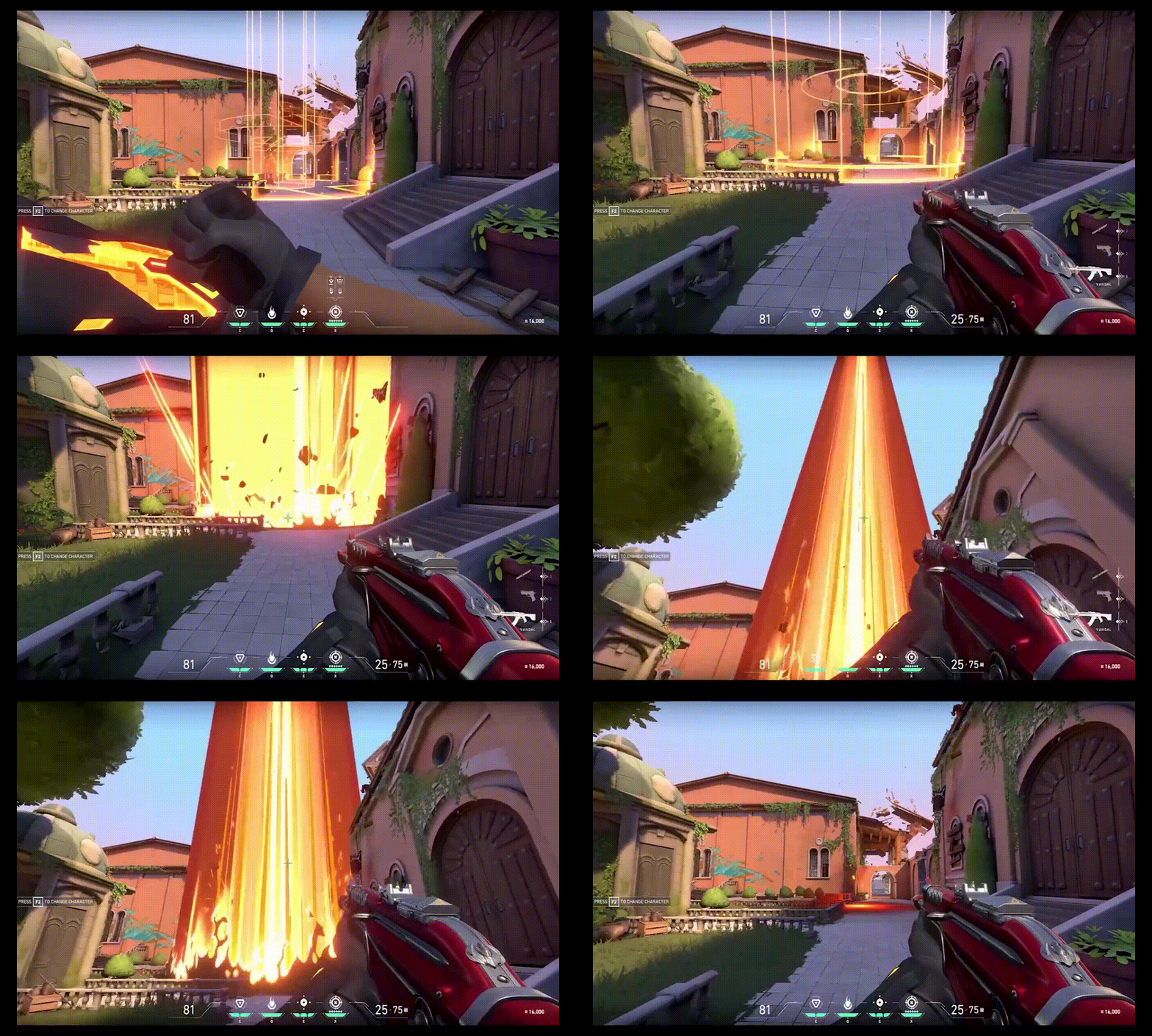
What’s the drawback?
A lot of these “deduction” abilities tend to leave some form of tracks that lead back to the player that used them. This means that your ability might make it easier for an enemy to know exactly where you are instead. For example, Raze has a Bomb Bot, which is a robot that simply hones in and explodes when it gets too close to an enemy. If Raze uses the bot around a corner and hears players shooting at, she can deduce that they’re close. However, if the Bomb Bot misses or goes the wrong way (it does this a lot), any enemy who spots it can easily trace it’s path back to where Raze is instead. In short, these kinds of deduction abilities are very strong and can be used for cornering players, but if used too rashly, can result in the opposite effect.
Layer 4: Teammate Information
This information is the most important, because your teammates can simply tell you where they’ve seen enemies and plan what is the best course of action with you. Even when a teammate dies they can spectate your perspective, giving you two sets of eyes on your problem.
What’s the drawback?
Like any team setting, being able to communicate effectively is a whole beast itself. Interpreting what your teammates said can also be a challenge when you only have 2 seconds to parse it. Also, trusting what they said is true is not something to overlook. We all make mistakes.
What does each character bring to the table?

There are 10 confirmed characters in Valorant so far, each with 4 different abilities. Listing them out here would be too much to do here and also unnecessary (All of them are listed here for those who are curious). I’ve boiled each character’s abilities down to 5 different types of playstyles:
- Mobile playstyle – This character’s ability primarily helps them move about the map or reach places others cannot easily.
- Deduction playstyle – As stated above, a lot of abilities may not give direct info, but observant players can use this to their advantage to get info anyways.
- Support playstyle – This character’s ability doesn’t boost them in action, but certainly does a big service to the greater team. Examples include info or health.
- Damage Playstyle – This character’s ability does boost them in battle, but it’s not through gun buffs though. Sometimes their abilities might be better than their guns.
- Recon Playstyle – This character’s ability offers a chance to get info, but it is up to the player to dole out what they find.
No character in the roster holds only one title, all of them at least hold two:
Sova – Deduction, Recon, Support
His recon bolts and drone allow him to give good info, but his ultimate, Hunter’s Fury, can either do serious damage or give away his location easily.
Viper – Deduction, Damage
Her clouds and puddles of acid help control the flow of the enemy’s movement and also deal damage to any players who cross through them.
Phoenix – Deduction, Recon
Putting up flashes and walls help deter movement and also damage enemies like Viper’s abilities, but his Ultimate, Run it Back, allows him to temporarily move as a ghost.
Omen – Deduction, Mobile
His ability to teleport allows him to support battle-wise and also makes for a quick escape if getting info. His Dark Cover abilities also can blind vision in choke points of the map.
Cypher – Recon, Support
He is all about either baiting the enemy with trip wires to give their location or spotting them with camera-like abilities.
Brimstone – Deduction, Damage, Support
His Stim Beacon allows for allies to gain rapid fire, but his Orbital Strike can either kill or block off part of the map for a while.
Breach – Deduction, Damage
Much like Brimstone, his ultimate also can tie up a big patch of the map with vision impairment. He also can shoot people through walls too with the right info.
Sage – Deduction, Recon, Support
She has the ability to heal players and resurrect them with her ultimate. Her ability to raise a wall changes the flow of the map for a good amount of time. She is possibly one of the best characters ability-wise.
Raze – Deduction, Damage
She has the ability to do lots of damage with her grenades and her ultimate. Her grenades and bomb bot can also bait players into revealing their location or push them out of claustrophobic locations.

As you can see from the roster above, each character contains special abilities that serve to benefit the team rather than the individual. The one character that bothers me on this roster is Jett. Her four abilities include:
- Cloudburst – She can lay down 3 vision blocking clouds much like Omen’s Dark Cover. This is a very useful move, because vision impairment is key for undercover movement. No complaints here.
- Updraft – This allows her to jump higher than normal. This is great for getting to higher parts of the map, but its uses on the map are very limiting for true places of unique reconnaissance.
- Tailwind – She can propel in a direction she is moving for a second. Much like updraft, it has a good use of an evade, but aside from that it doesn’t provide much for info.
- Blade Storm – She spawns 5 knives that can be thrown accurately for a kill. While a great offensive move, her ability serves no other purpose.

In a game that focuses on team coordinated movement, three out of the four of Jett’s abilities are pretty selfish. You could say Omen or Raze are pretty similar to Jett with these abilities. Omen’s teleport only benefits himself too, but I would argue that the distance in which he can teleport really can be used to provide quick support to teammates who are cornered unlike Jett’s shorter distance. You could argue that Raze’s abilities are purely damage based and are on an equal footing with team contribution to Jett. I would argue, however, that Raze’s grenades and Bomb Bot have a dual purpose of clearing out tight spaces. You could possibly see the benefit of a well placed grenade that can hold off a bomb from being planted or defused. As a whole, I feel that Jett has the least to offer character-wise that would make for a good teammate. We already established that every character has the same gun abilities so even her ultimate is at par with another player who is skilled with a sniper.
Does this mean that Jett players will start to phase out later down the line?
Absolutely not. Regardless of how team oriented a game is, there will always be players who want to strike their own path and move through the map in their own ways.
So what does Jett have to offer to the team?
Cloudburst aside, Jett’s ability to evade and jump makes her hard to hit. She could provide bait or hide in a high spot to surprise enemies. At heart, Jett’s character is more of an executor rather than a spy, but she will need all of the info she can get from other players first to actually be effective though.

If Jett isn’t going to fade out over time, what can we expect from the future of Valorant Teams?
I predict that team coordinated play will be essential in the future, not just from regular gunplay and positioning, but also from character’s abilities. I have heard streamers talk about how Sova’s ultimate is too slow or how Brimstone’s ultimate is too easy to evade, but I argue that most ultimates were never intended to be used alone. Over the short period of time I’ve been exposed to Valorant, I’m starting to see that certain combos of abilities are really effective when used concurrently. For example, for both Sova and Brimstone, trapping enemies with Sage’s slow orb makes killing them with their ultimates very easy. To that same notion, Jett could rush areas and provide recon from high areas which could be supported by Omen’s teleport if she does actually find enemies.
In essence, the more I watch Valorant, the more I start to think of the game like football. Each game has running backs and linemen. Neither can do the job alone, but over time, teams that learn to make playbooks that utilize each character’s abilities to the fullest will be the most successful. What makes this game exciting to watch is that at this moment, there is still a lot of tech to be discovered. Jett could end up being the best player on the team for all we know.

 Game Design - Hard Questions